Delhi Air Hits Dangerous Levels As Winter Returns
PM2.5 concentrations reached 157.9 micrograms per cubic meter, far exceeding safety guidelines, prompting renewed calls for year-round regional coordination.
By Madison Cooper ·
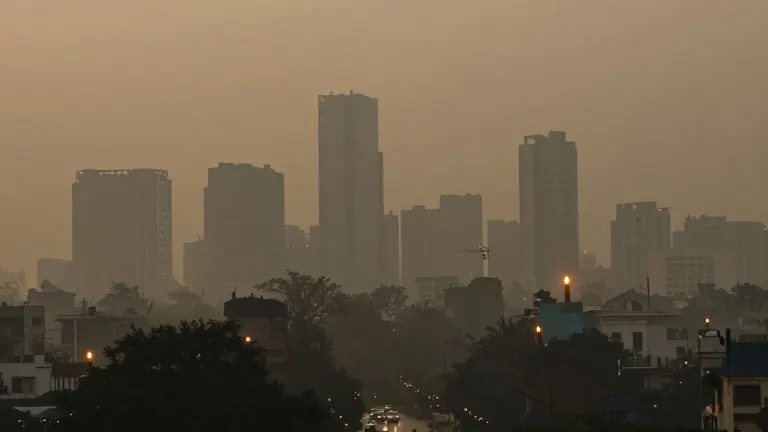
Winter has returned to New Delhi, bringing with it the city's annual struggle against hazardous air quality. The situation has reached a critical point as residents and officials grapple with a thick smog that blankets the capital.
IQAir, a Swiss air quality monitoring firm, reported that the city's air quality entered the "Very unhealthy" category. The average concentration of PM2.5 particles measured 157.9 micrograms per cubic meter. This figure is more than thirty times the World Health Organization's recommended annual safe limit of 5 micrograms. Tiny particles in this range can penetrate deep into the lungs and bloodstream, increasing risks for head and neck cancers.
The air quality deterioration follows a familiar seasonal pattern. Authorities typically implement emergency restrictions once levels become dangerous, but experts argue this reactive approach fails to solve the root causes. Sunil Dahiya, founder of the environmental group EnviroCatalysts, stated that the lack of coordination across the National Capital Region is the primary obstacle. Government data indicates that approximately 65 percent of Delhi's PM2.5 originates from outside the city limits. Neighboring areas such as Noida and Gurugram are major sources of these pollutants.
Dahiya noted that scientists have recommended year-round, source-specific actions for over a decade. Current measures remain largely seasonal. Long-term structural changes, such as the adoption of cleaner fuels and expanded public transport, are progressing slowly. Emergency tools like water sprinklers and smog towers are often deployed after pollution levels have already spiked.
Bhavreen Kandhari, co-founder of Warrior Moms, criticized the official response for prioritizing cleanup over prevention. She described the use of water sprinklers as a waste of public resources that offers visual relief without addressing underlying issues. Kandhari also pointed to the practice of incinerating waste as a factor that exacerbates the crisis.
Political dynamics further complicate efforts to manage the crisis. Delhi Environment Minister Manjinder Singh Sirsa attributed the rising pollution levels to stubble burning in the neighboring state of Punjab. He claimed that local sources like construction and vehicles were under control. Dahiya acknowledged that crop burning in Punjab and Haryana is a sharp contributor but stressed it is not the sole cause. Vehicles account for roughly 51 to 53 percent of local PM2.5. Secondary particulate formation from combustion in power plants and industry also contributes significantly to winter pollution.
For many residents, the crisis is a matter of daily endurance. Deepika, a domestic worker in South Delhi, reported a week-long cough. She said she has no choice but to tolerate the conditions for the coming months. Khushboo Arora, a local resident, sought additional air purifiers for her mother, who has underlying health issues. Arora described experiencing recurring headaches and a sense of heaviness that forced her to abandon outdoor activities like yoga and walking.
Namrata Yadav, a mother who participated in anti-pollution protests last November, expressed frustration at the repetitive nature of the problem. She described the experience of demanding clean air as exhausting and often met with dismissal. Residents and experts alike are calling for a sustained clean-air strategy that prioritizes year-round control, better inter-governmental coordination, and stricter enforcement of regulations with measurable targets.