Nevada Wild Horse Lawsuit: Three groups sue BLM to stop 600-horse roundup
Plaintiffs argue the Bureau of Land Management relies on outdated population data and that captured horses face imminent slaughter risks.
By Sophia Bennett ·
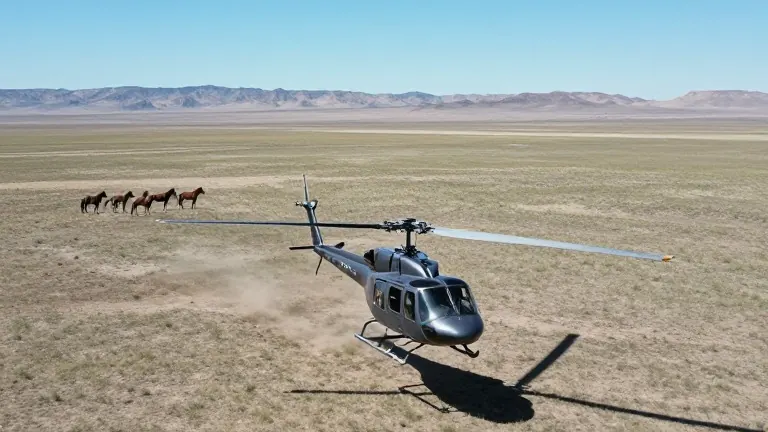
Three wild horse advocacy groups filed a federal lawsuit on Tuesday seeking to stop the Bureau of Land Management from capturing approximately 600 horses in central Nevada. The organizations, Montgomery Creek Preserve, Rewilding America Now, and Wild Horse Education, submitted the complaint to the U.S. District Court for the District of Nevada. They are requesting a temporary restraining order to halt helicopter-based capture operations scheduled to begin on Dec. 4 in the Clan Alpine herd management area and surrounding lands in Churchill County.
The groups contend that the BLM is violating the Wild Free-Roaming Horses and Burros Act by relying on a 2023 environmental assessment rather than current data demonstrating an excess population. The agency claims the Clan Alpine herd has doubled to 1,224 horses over the past two years. Planners cite this figure despite a 2023 roundup that captured 1,605 horses and reduced the population to 612, which marks the lower limit of the herd's target range of 612 to 979 animals.
The plaintiffs argue that the BLM’s growth estimate contradicts the agency’s own reference to an annual growth rate of 14.1%. They state the calculation ignores recent fertility control treatments, drought conditions, and the 2026 Shoshone and Blue Eagle fires, which burned 11% of the herd’s range. The groups also claim the agency withheld the March 2024 aerial census referenced in its decision. The BLM issued its roundup decision on Nov. 10 with immediate effect and without public notice.
Laura Leigh, founder of Wild Horse Education, noted that the BLM canceled a planned Clan Alpine roundup in 2011 after a new aerial count showed too few horses to justify the operation. She stated that the agency now appears to be repeating that error by planning another removal without first resolving underlying issues with its population data and management plan.
The lawsuit warns that Clan Alpine horses face an imminent risk of slaughter due to two specific factors. First, the Carson City District issued a seizure notice in September allowing the agency to capture unauthorized livestock for 12 months across 5.3 million acres. This area includes lands outside the herd management zone, where the agency counted 150 Clan Alpine horses in 2024. The groups argue the notice allows the agency to declare any horse as unauthorized livestock, and there is no public procedure to distinguish federally protected wild horses from lost domestic cattle. Horses classified as livestock lose federal protection and can be sold within days.
In September, 11 wild horses from the state-managed Virginia Range appeared in a South California feedlot that supplies slaughter buyers from other states. The Nevada attorney general is investigating the incident. The second factor cited in the lawsuit is the agency’s wild horse sales program, which The New York Times investigated this fall. The groups state that at least 28 Clan Alpine horses entered the slaughter circuit through sales programs between March 2025 and August 2026. This includes 18 of the 496 wild horses a dealer purchased from the agency. The New York Times linked that dealer to shipments of horses to slaughter in Canada.
Manda Kalimian, president of Rewilding America Now, said the lawsuit seeks to hold the BLM accountable for managing wild horses based on how they actually use the grassland. She questioned the gaps in the seizure notice that could send protected horses to the slaughter chain. Ellie Price, founder of Montgomery Creek Preserve, stated that the BLM has exceeded the limits Congress set to protect these animals, ignoring the laws that safeguard wild horses and public lands.