Florida voters cast ballots in decisive midterm races
As polls closed at 7 p.m. across the state, residents in Pensacola and other communities finalized their choices for governor and Congress, contributing to a national shift in power.
By Sophia Bennett ·
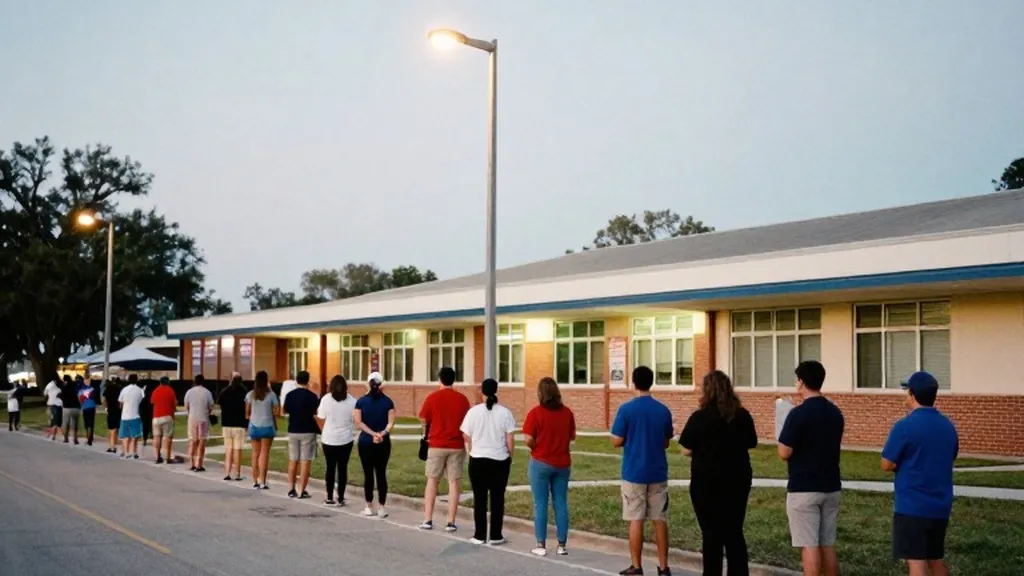
Voters in Pensacola and across Florida completed the 2026 general election on Tuesday, November 3. Polling places in the state were open from 7 a.m. to 7 p.m., a schedule that accounts for the state's division between the Eastern and Central time zones. Residents in Pensacola, Tallahassee, and Gainesville followed this timeline to cast their ballots for a slate of high-stakes offices. The election included every U.S. House seat in the state, a contest for the open governorship, and various state and local measures. The outcome of these local votes contributed to a significant national realignment in the balance of power in Washington.
For many Florida residents, the decision to vote at a physical location required navigating specific identification rules. Under state law, voters are generally required to present a valid photo ID to cast their ballot. This practical requirement meant that many voters in Escambia and other counties arrived at their designated polling places with driver's licenses, state ID cards, or other approved forms of identification. The process is designed to ensure the integrity of the vote while remaining accessible to citizens. The state of Florida does not hold a U.S. Senate election this year, making the governor's race the most prominent statewide contest for local attention.
The governor's race in Florida is an open seat, meaning no incumbent is running for re-election. This creates a unique dynamic for voters in Pensacola and the broader state, who must choose among candidates from the Democratic, Republican, Libertarian, and No Party Affiliation parties. The absence of an incumbent often leads to increased spending on advertising and a focus on the candidates' platforms rather than their legislative records. For voters in the panhandle, the choice of a governor has direct implications for state infrastructure, education funding, and economic development strategies that affect their daily lives.
Beyond the physical polling places, the election provided multiple avenues for participation. Many voters utilized mail ballots, a process that relies heavily on the United States Postal Service for timely delivery. The Postal Service works to ensure that ballots received by the deadline are counted, a logistical challenge that requires coordination across counties. In Pensacola, the volume of mail-in ballots has been a growing trend in recent cycles, reflecting a shift in how citizens engage with the democratic process. The combination of in-person and mail voting allowed for broad participation across the diverse communities of the state.
Locally, the election included contests for state and local offices that vary by county. These races determine who will represent specific districts in the state legislature and who will hold key municipal positions. In towns like Pensacola, these local elections are critical for decisions on zoning, public safety, and local infrastructure. The results of these races shape the immediate political landscape in which state and federal policies are implemented. Voters in the region had the opportunity to influence the direction of their local government through these specific contests.
Nationally, the 2026 midterms resulted in a major shift in the balance of power. Democrats won majorities in both the U.S. House and the Senate, marking a significant change from the previous composition of Congress. The party picked up at least 43 House seats, 42 of which were previously held by Republicans and one held by an independent. In the Senate, Democrats gained seven seats, all previously held by Republicans. These gains established a Democratic majority of at least 250 to 157 in the House and 54 to 44 in the Senate. This shift is considered a wave election, placing the results in the top 20% of election years in terms of seat swings against the president's party.
The national results also saw Democrats secure a majority of governorships for the first time since before the 2010 elections. Across the country, Democrats won 22 of the 36 gubernatorial races, with five changes in party control from Republicans to Democrats. This broadened Democratic control extends to state legislative chambers, where the party won 46 of the 88 contested seats. These victories mean that Democrats will have significant influence over state-level policy, including taxation, healthcare, and education, in many of the nation's largest and most populous states. The political landscape for the next two years will be defined by this new alignment of power.
The impact of these results is already being felt in the administration of the federal government. The shift in congressional control allows the new majority to assert its agenda on legislation and oversight. This change follows a period of transition within the White House, where President Donald Trump announced the appointment of Stephen Miller as the next chief of staff. Miller, known for his role in shaping the administration's immigration policies, steps into a position of significant influence. The timing of this political shift adds a layer of complexity to the relationship between the executive branch and the newly empowered Congress.
President Trump also made headlines for an unconventional announcement regarding his press secretary. He stated that he has offered the job to UFC boss Dana White, describing him as a "violent Fighter and Warrior." The president suggested that White would bring UFC fighters to serve as assistants to help defend the administration against what he called the "Lunatic Left." While the White House did not immediately confirm the offer, the announcement highlights the ongoing changes within the administration as it adjusts to the new congressional majority. The former press secretary, Katie Zacharia, had left the role after only five days, leaving the position vacant since the end of August.