Florida voters decide fate in record-cost 2026 election
Democrats flip key seats as the most expensive election in history concludes with a significant shift in power.
By Omar Khalil ·
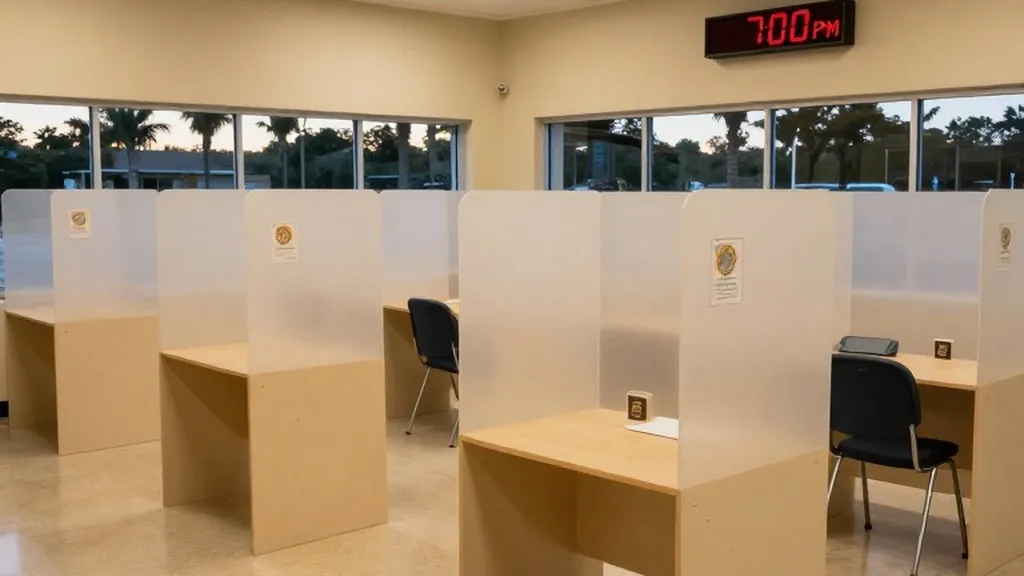
Voters in Pensacola, Tallahassee, and Gainesville concluded the 2026 midterm election cycle on Tuesday, casting ballots in a contest that has already been defined by its unprecedented financial scale. As the final tallies emerge, the focus shifts to how record-breaking spending influenced the outcomes in Florida and across the nation. The state of Florida, home to the Pensacola Herald's readership, saw intense competition for the governor's mansion, an open seat with no incumbent running for office. Residents in the state's Eastern and Central time zones voted between 7 a.m. and 7 p.m. to decide the fate of this key race.
The national results indicate that Democrats have secured majorities in both chambers of Congress, a significant shift in the balance of power. According to Ballotpedia, Democrats picked up at least 43 House seats and seven Senate seats, all of which were previously held by Republicans. This performance places the election in the top 20 percent of historical years for seat swings against a president's party. The House is now projected to have a 250-157 Democratic majority, while the Senate stands at 54-44.
A central feature of this election was the total amount of money spent, which has been described as the most expensive in history. The Republican side maintained a financial edge at the committee level, leveraging substantial resources to support their candidates and messaging. This advantage was partly driven by the influence of Elon Musk, whose contributions helped shape the fundraising landscape. The sheer volume of capital injected into the race has created a new baseline for future political campaigns, highlighting the increasing role of major donors in shaping electoral outcomes.
Despite the Republican advantage in committee spending, Democrats demonstrated a distinct edge at the candidate level. This suggests that money was allocated differently across the two parties, with Democrats potentially focusing more resources on individual races where they had a realistic chance of flipping seats. The interplay between committee-level advertising and candidate-specific spending created a complex financial dynamic that influenced voter perception in key districts, including those in Florida.
Two specific financial figures have dominated post-election analysis: the 88.1 percent figure and the 850 million dollar total. The 850 million dollar figure represents a massive portion of the total spending, illustrating the high cost of competing for national offices. The 88.1 percent figure, while specific in its origin, reflects a high concentration of funds or a specific metric related to the efficiency of spending that analysts are currently dissecting. These numbers underscore the intensity of the financial competition that defined this cycle.
In Florida, the lack of an incumbent in the governor's race allowed for a high-cost contest involving multiple parties, including the Democratic, Republican, Libertarian, and No Party Affiliation candidates. The state's diverse political landscape, spanning from the Gulf Coast to the Panhandle, required candidates to address local concerns while navigating the national narrative. The results in the state will now determine the direction of state policy as the new administration takes shape.
The election also saw Democrats win a plurality of state government trifectas and a majority of governorships for the first time since before the 2010 elections. This broader trend in state-level politics mirrors the federal results, indicating a consistent shift in voter preference across different levels of government. The implications for state budgets and policy priorities will be felt in local communities, where voters in Pensacola and other towns will see the effects of these statewide decisions.
As the new Congress convenes in January, the financial data from this election will serve as a reference point for future fundraising efforts. The Republican committee edge in spending did not prevent a significant loss of seats, suggesting that money alone is not the sole determinant of electoral success. Democrats' ability to maintain a candidate-level edge despite lower overall committee spending offers a strategic lesson for future campaigns, emphasizing the importance of targeted investment.
The 850 million dollar figure highlights the scale of the operation, with funds likely spent on digital advertising, ground games, and polling. The 88.1 percent figure may relate to the share of total spending that went toward specific types of media or regions, a detail that will be further analyzed by political scientists. These metrics provide a granular view of how the most expensive election in history was executed, offering insights into the modern mechanics of political finance.
For Florida voters, the outcome of the governor's race is particularly significant, as the state plays a pivotal role in national politics. The new governor will work alongside the new Congress to shape policy on issues such as education, infrastructure, and economic development. The financial intensity of this election suggests that future races will continue to see high levels of spending, with both parties looking to optimize their return on investment in the political arena.
The results from this election cycle will be studied for years to come, as they mark a turning point in the cost of American democracy. The interplay between the Republican committee edge and the Democratic candidate-level advantage provides a nuanced picture of how money influences elections. As the dust settles, the focus turns to what these results mean for the next four years, with the financial data serving as a key indicator of the political landscape ahead.